
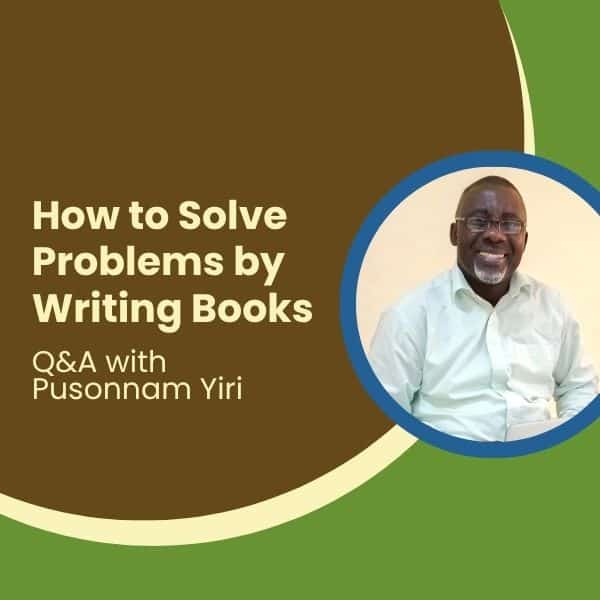
Author and book coach Pusonnam Yiri shares the importance of writing books—not just any books, but books that actually solve problems and are written with their audiences, not only for their audiences.
We’d love to know how you came to faith in Christ.
I’m from a Christian home. My father was a minister. My real journey started in 1991. One night in secondary school, I didn’t have peace. In my room, I prayed to the Lord to come into my life—and after that, I felt the peace that nobody can take away from me. Today, I’m a minister. My wife and children love the Lord. My first son is now a minister, too.
Please share about your journey into Christian publishing ministry.
I have a background in mass communication, and started in ministry as a script writer, producer, actor and director of the first film we did. I then went to seminary, and from there wrote my first book. By the time I attended a writer’s workshop organized by ACTS in 2010, my first book was published—a compilation of short stories called 151 Life-Changing Short Stories and Their Lessons. Afterwards, I had a burden to start my own writer’s workshop, so I started training writers that same year.
My father, Jackson Doko Yiri, wrote many things. He documented his sermons very well, as well as many devotions—but he didn’t write a book. Because my father didn’t write a book, after his death, a reality hit me—a generation will arise that will not even know my father. That really hit me hard, and contributed to the idea of helping leaders to conserve their stories and their values.
Many leaders are dying undocumented—and if we don’t conserve their stories, they will lead and disappear, and subsequent generations will repeat all their errors. I’m passionate about helping leaders to tell their stories, to conserve their values so that subsequent generations can interact with their values, and create and develop new things.
Somebody said that if you don’t write it, it didn’t happen. When an elder dies, a library burns to the ground.
I believe a book can lead to a sustainable development, but if our leaders keep on dying undocumented it’s not going to help our children. It’s not going to help our grandchildren. They will probably repeat the errors of their fathers and their grandparents. I’m hoping to bring all of my father’s notebooks together, and one day publish a book about him. I’m also currently mentoring two of my children to learn what I’m doing in this area.
Do you have advice for writers to think through before they approach you for book coaching?
1 A book must be a solution to a problem. What is the book for? Which problem will the book solve? A writer must understand that. I would advise to start with problem identification.
2 Your book must be an original solution to that problem. It must also be local—in the sense that the majority of your content is from primary sources. A new book must have new content or a new methodology of capturing an existing idea.
3 Know your audiences very well and involve them in the book. Understand your primary, secondary and tertiary audiences. Write with your audience, not for your audience. You need to research, go out there and ask questions—you have to really know that your audience needs your book.
4 Know what qualifies you to write the book. I believe that books are written expertly. This is not limited to academic expertise, but an expert is somebody who knows a subject very well. Are you the best person to share this story and these lessons, from your own lived experience?
What’s distinctive about the writer’s workshops you offer?
I see excellence as worship. Whenever I am working on a project, I give it my best. We have trained hundreds of authors, many of whom are leading organizations.
I love original thinking. I love bold thinking. The authors I’m focusing on now are leaders who are sharing their stories, fresh ideas, and lessons from their leadership experiences. They are original and bold authors who are thinking locally and sharing globally. They are committed, teachable, easily work with a team, already have speaking platforms, and have their own local experiences.
I had started out with the seminar approach, but found that although people received information, they didn’t use the information well. So I asked myself, “What happened?” The way I train writers now is while they are working on their project. It is a project-driven approach that involves my journeying with writers.
I have an incubation period to test the idea. I believe that an idea must be cooked properly. If we don’t do that, we may end up releasing ideas that are not properly cooked. I don’t work with a launching deadline. I am more interested in the quality of the content.
I can work with an author for 3-6 months—even a year or more, depending on the nature of the book. The book is the author. The quality of the author leads to the quality of the book. I help you to become a good author, by God’s grace—to conserve your journey, your experiences, your lessons for current and future generations.
Pusonnam Yiri is an author, speaker, trainer, chairman and managing director of the Nachau Turomale Center LTD in Nigeria. He has been training writers since 2010, including at LittWorld in 2015 and 2018. Pusonnam also served as a judge for MAI’s 2021 writing contest. He is committed to seeing books then turn into international organizations, conferences, training centers and mass movements.
Related links and stories
- How to Turn Your Leadership Experiences into a Book – a webinar with Pusonnam Yiri
- Lead Well, Write Well – a webinar video featuring Pusonnam Yiri
- Taking the Ordinary and Making It Extraordinary in Your Writing – a short video featuring Pusonnam Yiri on developing ordinary and small things into something big and extraordinary.